Key Takeaways
- Waking at 3AM has a straightforward physiological explanation — it’s not mysterious or alarming.
- Sleep cycles, cortisol, body temperature, and environmental cues all converge around the 3–4AM window.
- Waking at the same time every night is often a learned pattern your brain has reinforced — not a sign something is wrong.
- Most spiritual or symbolic explanations for 3AM waking have no scientific basis, though they’re worth understanding calmly.
- How you respond in the first few minutes after waking determines how quickly you fall back asleep.
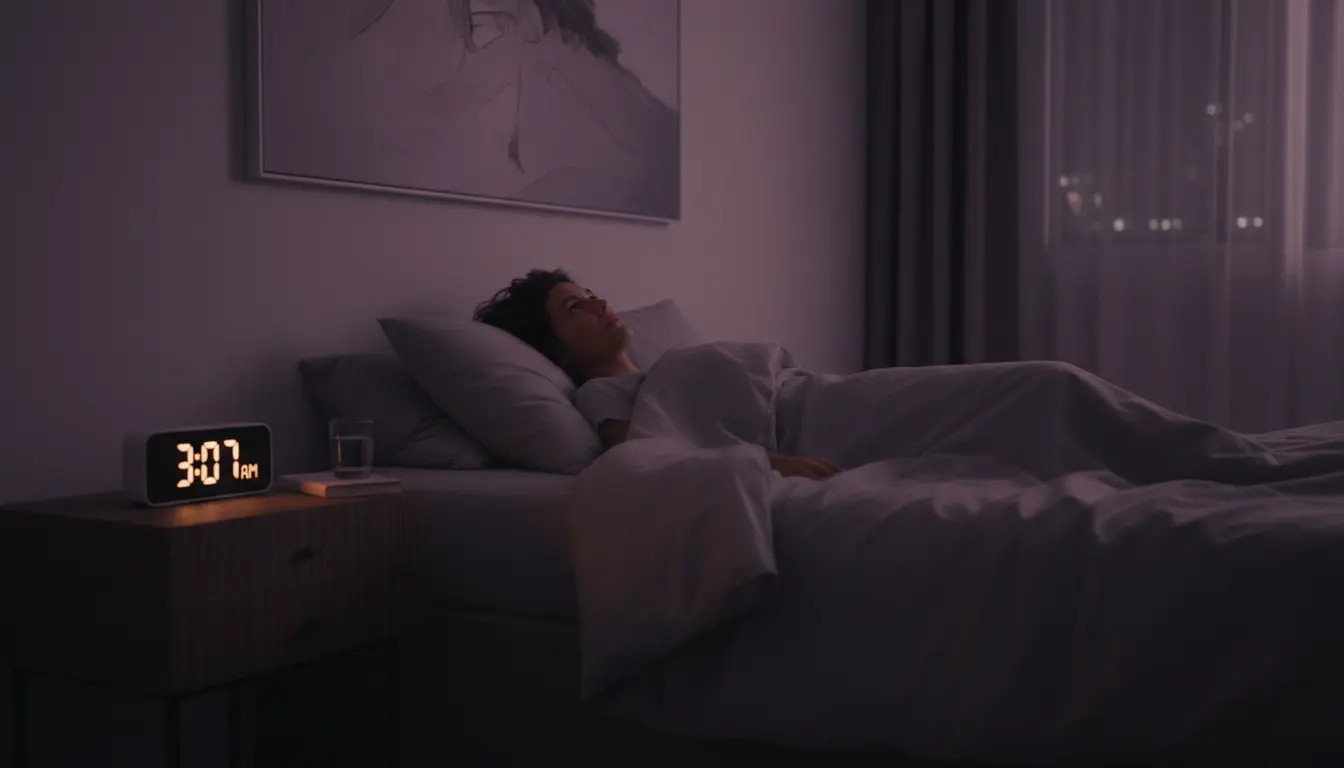
You’re asleep. Then suddenly, you’re not. You open your eyes, and something makes you reach for your phone or glance at the clock — and there it is. 3AM. Again.
If this feels familiar, you’ve probably found yourself wondering what it actually means when you wake up at 3AM. And if you’ve spent any time searching for answers online, you’ll know that the internet has a lot of opinions on this — some grounded in sleep science, many not quite.
There are spiritual interpretations, folklore-based theories, and plenty of dramatic explanations that can leave you feeling more unsettled than when you started. The truth is both simpler and more interesting than most of those accounts suggest. Your body has real, understandable reasons for what it does at 3AM — and once you understand them, the whole thing becomes a lot less worrying.
Quick Answer
Waking up at 3AM most often means your brain has moved into a lighter stage of its sleep cycle, making brief awakenings more noticeable. Cortisol — your body’s alertness hormone — also begins rising naturally around this time. For most people this is completely normal and not a sign that anything is wrong.
Is There Something Special About 3AM?
In a way, yes — but not in the way most people think.
For the average adult who goes to bed somewhere between 10PM and midnight, 3AM falls right in the middle of the night. And that timing matters, because sleep doesn’t stay in one consistent state from the moment you close your eyes until your alarm goes off. It cycles.
Roughly every 90 minutes, your brain moves through a sequence of sleep stages — from light sleep down into deep, restorative sleep and back up again into REM (the dreaming stage). Each time the cycle completes and begins again, you pass through a lighter phase where waking is much easier.
By 3AM, most people have completed three or four of these cycles. The deep, slow-wave sleep that dominates the early part of the night has largely run its course. What’s left is mostly lighter, REM-rich sleep — which is beautiful for dreaming and memory consolidation, but also makes you considerably easier to wake.
So the reason 3AM feels like a significant moment isn’t because of anything mystical — it’s because it falls in a naturally light stretch of sleep for a large portion of the population.
Why Do People Wake Up Around 3AM? The Real Reasons
Sleep cycle timing is the foundation, but several other factors layer on top of it — and understanding them helps explain why some people experience this more reliably than others.
Cortisol Begins Rising
Cortisol is your body’s primary alertness hormone, and it doesn’t politely wait for your alarm clock. It begins climbing naturally in the early morning hours — typically from around 3AM onward — as part of your body’s preparation for waking up. For some people, this rise is gradual and gentle. For others, it’s enough to push them from light sleep into full wakefulness.
Core Body Temperature Shifts
Your body temperature drops as you fall asleep, supporting the deeper stages of your sleep cycle. Around 3–4AM it begins to rise again. This subtle internal shift often coincides with lighter sleep stages, and combined with a room that may have warmed slightly overnight, it can be enough to nudge you awake.
Circadian Rhythm Timing
Your circadian rhythm — the internal 24-hour clock that governs sleep, wakefulness, hunger, and dozens of other biological processes — has its own schedule. For most adults, there’s a natural dip in alertness late at night and another in the early afternoon. The transition out of the nighttime dip begins in the early hours of the morning, which can contribute to easier waking around 3AM.
Environmental Disturbances
Light creeping in through curtains, early morning traffic, a partner shifting position, heating or cooling systems switching on — during lighter sleep stages, the brain continues to monitor the environment. Stimuli that you’d sleep straight through at 10PM can register as a reason to wake at 3AM.
Why Some People Wake at Exactly the Same Time Every Night
This is where it gets particularly interesting. If you wake up at 3AM not just occasionally but almost every single night — often within minutes of the same time — there’s a specific reason for that consistency.
The brain is extraordinarily good at anticipating patterns. When something happens repeatedly at a similar time, your brain begins to prepare for it in advance. Researchers call this conditioned arousal — essentially, your brain has learned to expect waking at 3AM and starts ramping up alertness in anticipation.
It works much like an internal alarm clock. If you woke at 3AM last Tuesday, Wednesday, and Thursday — even for entirely different reasons — your brain starts to treat that time slot as significant. It begins quietly increasing alertness from around 2:45AM onward, making the wake-up almost self-fulfilling.
Stress and anxiety can reinforce this pattern significantly. If you’ve spent several nights lying awake at 3AM worrying about something — work, health, relationships — your brain begins to associate that time with a state of alert rather than rest. That association can persist long after the original stressor has passed.
The reassuring part is that learned patterns can also be unlearned. Breaking the cycle usually doesn’t require anything dramatic — it mostly involves changing how you respond when you wake, which we’ll come to shortly.
What About the Spiritual Meaning of Waking at 3AM?
It wouldn’t be honest to write about this topic without addressing the elephant in the room. Search “waking at 3AM” and you’ll find no shortage of spiritual interpretations — references to the witching hour, suggestions that the body is receiving messages, or theories about heightened sensitivity during that window.
These ideas clearly resonate with a lot of people, and it’s worth treating them with respect rather than dismissiveness. Sleep has always carried cultural and spiritual significance across human history, and the experience of waking alone in the dark at an odd hour does have a certain quality to it that invites reflection.
That said, from a physiological standpoint, the timing of night waking is very well explained by sleep cycles, cortisol rhythms, circadian timing, and environmental cues — none of which require a supernatural explanation. The reason 3AM features so prominently isn’t because it’s a special hour in any metaphysical sense. It’s because it falls in a light sleep window for a large portion of the population, and humans are pattern-seeking creatures who notice and remember it.
If spiritual frameworks help you feel calmer during a night waking — less anxious, more at peace — then they’re serving a genuinely useful purpose. Calm is exactly what the brain needs to fall back asleep. But if those interpretations are making you more alert or more worried, the physiological explanation is likely more helpful.
I’ve worked with clients who came to me genuinely scared after reading spiritual or symbolic interpretations of 3AM waking online. My approach is always to start with the physiology — cortisol, sleep cycles, circadian transitions — because once someone understands how their body works, the fear usually lifts. That doesn’t mean I dismiss the spiritual dimension if it matters to someone, but I’ve found that calm always returns faster when we start with what the body is actually doing.
Understanding why you wake at 3AM is the first step. But when you’re actually lying there at 3AM, it helps to have a simple plan for what to do next. The 3AM Wake-Up Reset Guide is a calm, step-by-step approach designed to help you fall back asleep without stress or struggle.
What Actually Helps You Fall Back Asleep

Once you understand that 3AM waking is a physiological event and not a crisis, the next question becomes practical: what do you actually do to fall back asleep after waking at night?
The short answer is — as little as possible. The brain falls back asleep most readily when it receives the signal that nothing interesting is happening. Every action you take that increases alertness — checking the time, picking up your phone, turning on a light, running through tomorrow’s schedule — works against that signal.
Keep the room dark. Light is one of the strongest cues your brain uses to distinguish night from day. Even brief exposure to bright light at 3AM can suppress melatonin and push your brain toward wakefulness for longer than you’d expect.
Resist the clock. Knowing the exact time rarely helps. It usually just gives your brain a number to calculate with — how many hours until I have to get up, how long have I been lying here — which increases rather than reduces alertness.
Stay physically still. Movement signals wakefulness to the nervous system. Even if your mind feels active, keeping your body relaxed and still sends a quieting message to the brain.
Breathe slowly and deliberately. A longer exhale than inhale — try breathing in for 4 counts and out for 6 — activates the parasympathetic nervous system and begins to physically lower your heart rate and alertness level.
Give your mind something gentle. Not a problem to solve. Something repetitive and low-stakes — counting slowly, mentally walking through a familiar place, focusing on the physical sensation of breathing. The goal is to occupy just enough of your attention that anxious thoughts don’t fill the space.
For more detail on building a bedroom environment that supports falling back asleep, the SnoozeValley guide on how to create the ideal sleep environment covers the practical setup side of things well.
If You Need to Get Up, Light Choice Matters
Sometimes you do need to move around at night — a bathroom visit, a drink of water, checking on someone. When that happens, the light you use makes more of a difference than most people realise.
White and blue-toned light — the kind that comes from overhead bulbs, phone screens, and most lamps — suppresses melatonin quite effectively. That’s useful in the morning, but at 3AM it’s the last thing you want. Even a few minutes of bright white light can delay your body’s return to sleep mode.
Red and amber light sits at the opposite end of the visible spectrum and has a much gentler effect on melatonin production. It gives you enough visibility to move around safely without convincing your brain that morning has arrived. You can read more about the research behind this in the SnoozeValley article on whether red light affects melatonin.
A simple low-wattage red night light for sleep by the bed is one of the easiest environmental changes you can make for better middle-of-the-night recovery. If you’re not sure where to start, our guide to the best plug-in red night light covers the most practical options available.
A dim red nightlight is one of the simplest tools for protecting your melatonin if you need to move around during the night.
When to Take It More Seriously
For most people, occasional or even nightly 3AM waking is a rhythm issue — manageable with small environmental and behavioural adjustments. But it’s worth knowing when to look a little deeper.
If your night waking is accompanied by persistent daytime exhaustion, significant mood changes, loud snoring, gasping, or physical discomfort, it may point to something that warrants a conversation with your doctor. Conditions like sleep apnea, anxiety disorders, and hormonal imbalances can all manifest as regular night waking — and they respond well to the right support.
If you’re interested in improving the depth and quality of your sleep overall — not just navigating the 3AM moments — it’s worth exploring what happens during your deeper sleep stages. The SnoozeValley article on how to increase deep sleep goes into the practical detail of strengthening the most restorative part of your cycle.
The Bottom Line
Waking up at 3AM doesn’t mean something is wrong with you. It doesn’t carry a hidden message, and it isn’t a sign your sleep is broken. It means your sleep cycle has moved into a lighter phase, your cortisol has started its morning climb, and your brain is doing exactly what it evolved to do.
The experience becomes a problem mostly when we treat it as one — when the frustration, the clock-checking, and the anxious thinking turn a two-minute stir into a two-hour wakefulness spiral.
Approach it differently. With a little curiosity instead of alarm, a little stillness instead of activity, and the understanding that your brain already knows how to find its way back to sleep — it usually does.
💡 Worth Remembering
Most people who wake at 3AM fall back asleep within minutes when they stay calm and avoid stimulation. The waking itself is rarely the issue. It’s the response to the waking that determines how the rest of the night goes.
Frequently Asked Questions
What does it mean when you wake up at 3AM every night?
Waking at 3AM every night usually means your brain has developed a conditioned arousal pattern — it’s learned to expect waking at that time and begins increasing alertness in anticipation. This is reinforced by sleep cycle timing, cortisol rhythms, and sometimes stress. It’s very common and generally not a sign of a medical issue.
Is waking at 3AM a spiritual sign?
Various spiritual and cultural traditions assign significance to the 3AM hour. From a physiological standpoint, waking at this time is well explained by sleep cycles and circadian biology. If a spiritual framework helps you stay calm during a night waking, it can be genuinely useful — calm is exactly what the brain needs to fall back asleep.
Why do I wake up at 3AM feeling anxious?
Cortisol — the alertness hormone — begins rising naturally around 3AM. If you’re already carrying stress or anxiety, this hormonal shift can amplify those feelings during a light sleep stage, making the waking feel more charged than it would otherwise. Slow breathing and staying physically still are the most effective immediate responses.
What is the 3AM witching hour?
The “witching hour” is a folkloric concept with roots in various cultural traditions, often associated with heightened supernatural activity in the early hours of the morning. In sleep terms, 3AM is notable simply because it falls in a lighter sleep window for many adults, making waking more likely and more memorable.
How do I stop waking up at 3AM every night?
The most effective approach is to change how you respond when you wake — staying still, avoiding light and screens, resisting the urge to check the time, and using slow breathing to lower alertness. Over time, breaking the habitual response helps the brain stop treating 3AM as a significant event. Environmental factors like room temperature, light, and noise are also worth reviewing.
Can stress cause waking at 3AM?
Yes. Stress elevates cortisol and keeps the nervous system in a state of low-level alertness that makes night waking more likely and harder to recover from. It can also create conditioned arousal — where the brain associates 3AM with a stress response and begins preparing for it automatically.
About The Author