A gentle place to start Soft
If you’re reading this late at night (or during the day after a rough night), there’s a good chance you know the exact feeling:
Your body is exhausted… but your mind is still “on.”
You lie down and suddenly your brain thinks it’s time to:
- replay conversations
- plan tomorrow
- solve every problem you’ve ever had
- remember one weird thing you said in 2014
And the more you try to force sleep, the more alert you feel.
If that’s you, You are in the right place!
You’re having a very human nervous-system response — especially if life has been loud, stressful, busy, emotional, or just… a lot.
This “wired but tired” pattern is common. It doesn’t mean you’re broken. It usually means your system hasn’t learned (yet) how to shift from thinking-mode into resting-mode on demand.
L-Theanine is one of the options some people use as a soft nudge in that direction. Not a fix. Not a knockout. Just support.
L-Theanine is not a sleep pill
Let’s be super clear so there’s no weird expectations:
L-Theanine doesn’t knock you out.
It’s not a sedative. It doesn’t force sleep. It doesn’t “shut your brain off.”
If you’re hoping for a switch-flip moment — take something → pass out → stay asleep all night — L-Theanine probably won’t feel like that.
What it can feel like is more like:
- “My mind isn’t gripping so hard.”
- “The edge is lower.”
- “I can stop chasing thoughts.”
- “I can rest without needing to solve everything first.”
It’s not about pushing you into sleep. It’s more about making the space around sleep feel quieter.
What L-Theanine supports
When people say L-Theanine “helps with sleep,” what they usually mean is that it helps with the part before sleep — the transition.
Not everyone struggles because they aren’t tired. A lot of people struggle because their mind won’t release.
L-Theanine tends to support things like:
- Mental quiet (less mental chatter, less internal noise)
- Reduced urgency (the “I need to figure this out right now” feeling softens)
- Easier downshift (moving from thinking → resting feels more natural)
- A calmer bedtime experience (less wrestling, less negotiating with your brain)
It’s subtle. And that’s kind of the point.
If you’re here just to see the type of L-Theanine I usually point people toward, you can find an example Click Here
If your system is used to running hot, gentle support can be more helpful than anything that feels like a hammer.
Who L-Theanine tends to help
L-Theanine tends to be a better fit for people whose sleep problems feel mental more than physical.
It often helps:
- Overthinkers who can’t stop analyzing once the lights go out
- Late-night planners who suddenly want to reorganize their whole life in bed
- People who feel weirdly alert the moment they lie down
- People stuck in stress loops (“What if tomorrow goes badly?” “Did I forget something?”)
- Anyone whose bedtime feels like a mental “catch-up session” with all the thoughts they avoided during the day
If your sleep struggle feels like a mind that won’t un-clench, L-Theanine is one of the gentler tools people try first.
Who it may NOT help much
This is important too — not in a discouraging way, just in an honest way.
L-Theanine may not do much if your sleep issue is mostly driven by things like:
- Circadian mismatch (your body clock is shifted; you’re trying to sleep when your system isn’t ready)
- Highly disrupted routines (inconsistent wake times, late-night light/screen exposure, irregular sleep windows)
- Strong physical discomfort (pain, breathing issues, reflux, etc.)
- Expecting an instant, dramatic effect (this tends to be a “soften the edges” tool, not a “change your life overnight” tool)
Also: if you’re dealing with severe, ongoing insomnia, L-Theanine might still be supportive — but it’s rarely the whole story.
It’s okay if it’s not your tool. Choosing “none” is a valid choice here.
How people usually use it
Most people use L-Theanine in one of two ways:
1) Situational support : On nights when the mind feels extra loud. The “I’m tired but my brain is sprinting” nights.
2) A short nightly experiment : Some people try it nightly for a bit to see if it helps the bedtime transition feel smoother — then they keep it only if it genuinely feels useful.
There’s no one “right” way. Flexibility is part of what makes it feel emotionally safe.
Timing doesn’t have to be rigid either. Some people take it as they start winding down. Some take it closer to lying down. The goal isn’t precision — it’s support.
About dosage (keeping it simple):
You’ll commonly see amounts in the 100–200 mg range. Some products go higher, but more isn’t always better — especially if you’re the type of person who tends to over-monitor results. If you’re trying it, a gentle approach usually feels best.
And one practical note: if you’re on medications, pregnant, or managing health conditions, it’s worth checking in with a clinician/pharmacist you trust — not because L-Theanine is “scary,” but because your situation deserves personal care.
What noticing change often looks like
For many people, if L-Theanine helps, it’s not a dramatic “wow” moment.
It’s more like:
- “That night felt a little less sharp.”
- “I didn’t spiral as hard.”
- “I noticed I stopped chasing thoughts sooner.”
- “I still had thoughts, but they felt… farther away.”
Some people notice something the first few times. Others only notice after a week or two, when they look back and realize bedtime has been a bit less of a battle.
And some people don’t notice much at all — which doesn’t mean anything is wrong with you. It just means your sleep friction might be coming from a different place.
One helpful mindset:
- Don’t look for sedation. Look for easing.
Less edge. Less urgency. A slightly smoother landing.
A simple option, if you want one
If you want to see the type I usually point people toward, it’s this:
A simple, single-ingredient L-Theanine supplement (no “kitchen sink” blends), ideally with clear labeling and third-party testing listed by the brand. I also prefer capsules that keep the dose straightforward, so you’re not guessing what’s doing what.
Here’s the one I recommend most often when someone is wired-but-tired and wants a gentle option:
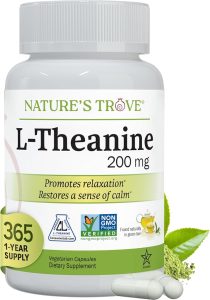
Nature’s Trove L-Theanine 200mg Super Value Size – 365 Vegetarian Capsules
Disclosure: Some links on this page are affiliate links. This means Snooze Valley may earn a small commission if you choose to purchase — at no extra cost to you. Recommendations are made thoughtfully and without obligation.
No pressure to buy it — truly. This is optional support, not a requirement. If your gut says “not for me,” listen to that. Sleep gets better when you build trust with your system, not when you force it into a plan.
If you do try it, keep your expectations soft: you’re not looking for a knockout. You’re looking for a quieter doorway into rest.
If this isn’t your path, that’s okay — we’ll keep exploring what helps your system feel safe enough to rest.
This article is for educational purposes only and is not a substitute for medical advice.
About The Author