If you’ve ever Googled does magnesium help with sleeping, you’re not alone. Magnesium has long been a supplement, similar to Melatonin that help humans with their sleep.
Key Takeaways
- Magnesium influences melatonin, muscle relaxation, and the nervous system—three pillars of good sleep.
- Some studies show magnesium may shorten sleep latency and improve sleep quality, especially in people with low magnesium.
- Typical sleep-supportive doses range from 200–400 mg, depending on form and tolerance.
- Not all magnesium is equal—glycinate and citrate are often best for sleep, while oxide is poorly absorbed.
Wellness forums rave about, and even sleep doctors now talk about it as part of a healthy nighttime routine.
But trends aside, many adults just want one thing:
to fall asleep faster and stay asleep through the night without feeling groggy in the morning.
Let’s dig into the real science, real experience, and real guidance behind magnesium for sleep—without the fluff.
I’ve spent hours combing through clinical trials, NIH data, and sleep-medicine sources (like the Cleveland Clinic and Mayo Clinic) to help you understand what magnesium does in your body, whether it works, and how much you might take if you decide to try it.
What Magnesium Actually Does in Your Body (and Why It Matters for Sleep)
Magnesium is a mineral your body uses for hundreds of tasks. The National Institutes of Health (NIH) notes it plays a role in nerve function, muscle relaxation, heart rhythm, energy production, and more.
But when it comes to sleep, magnesium touches three big areas:
1. It helps regulate your stress response.
Magnesium calms the sympathetic nervous system—the part that triggers the racing-mind, wired-but-tired feeling. Researchers have found that low magnesium can increase anxiety-like responses, which often interfere with falling asleep.
2. It supports melatonin production.
Melatonin is your “sleep hormone,” and magnesium is one of the minerals needed to regulate the enzymes that control your circadian rhythm.
3. It relaxes your muscles.
If your sleep is interrupted by tension, restlessness, or muscle tightness, magnesium’s role in muscle relaxation is often noticeable.
So the mechanics make sense. But lets see if it translate into actual better sleep?
Does Magnesium Actually Help You Sleep? What the Research Says
The short answer:
Yes — magnesium can help people fall asleep faster and sleep more deeply, especially if they’re deficient or highly stressed.
But magnesium is not a “sleeping pill.” It’s more like giving your nervous system a gentle nudge toward calm.
The evidence, in plain English:
1. Older adults saw real improvements.
A well-known randomized clinical trial published in the Journal of Research in Medical Sciences found that adults who supplemented magnesium:
- Fell asleep faster
- Slept longer
- Woke up fewer times
- Had higher melatonin levels
This is one of the most cited magnesium–sleep studies—and it’s why many clinicians mention magnesium for age-related insomnia.

2. Low magnesium levels correlate with lighter, more restless sleep.
According to the NIH, about 50% of adults don’t get enough magnesium from food.
Low levels are linked to:
- Restlessness
- Difficulty relaxing
- Poor sleep quality
So supplementation may help simply by restoring what your body needs.
3. Stress and anxiety respond to magnesium.
A review from Nutrients found magnesium supplements reduced mild to moderate anxiety.
For many people, less anxiety → easier sleep.
4. Magnesium supports GABA, the calming neurotransmitter.
GABA is basically your brain’s “off switch.”
Magnesium helps GABA receptors work better, according to the Journal of Neuropharmacology.
So what’s the verdict?
Magnesium isn’t a cure, but the clinical evidence and user experience both point in the same direction:
👉 If your sleep struggles are tied to stress, tension, or low magnesium intake, magnesium supplementation can meaningfully help.
How Many mg of Magnesium for Sleep?
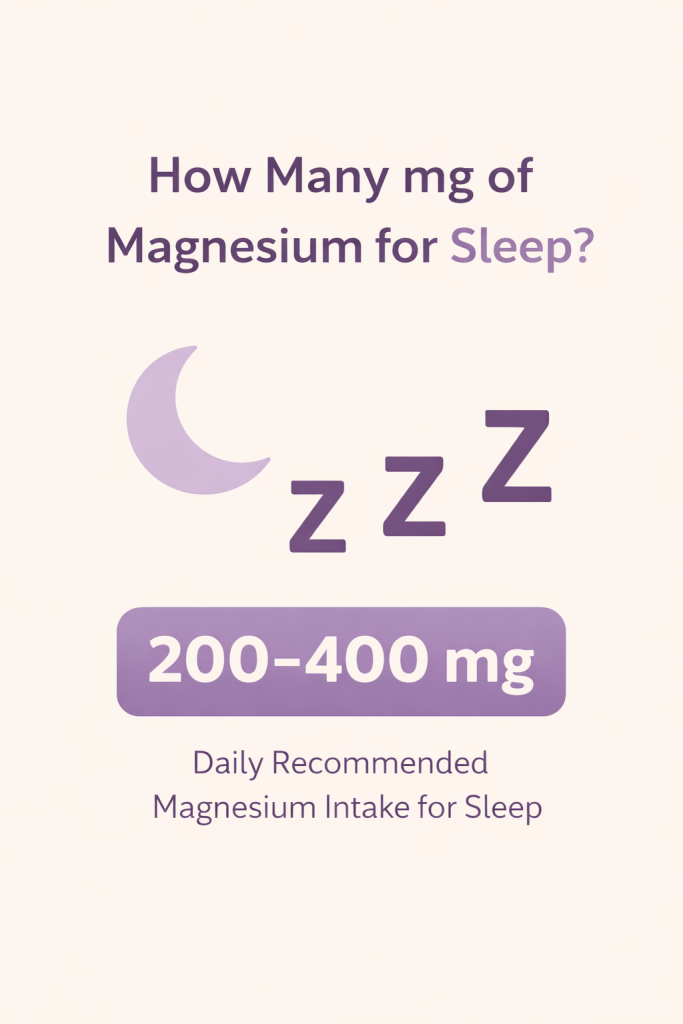
Most adults use somewhere between 200–400 mg of magnesium before bed.
But the right amount depends on:
- Your digestive tolerance
- The magnesium form
- Any other supplements you’re taking
- Whether you get magnesium from food
General guidance from medical sources:
- The NIH lists 310–420 mg as the recommended daily intake for adults (from food + supplements combined).
- Sleep specialists often recommend 200–300 mg of magnesium glycinate because it’s well-absorbed and gentle on digestion.
If you’re brand new to magnesium:
Start low → 100–150 mg.
Then move up to 200–350 mg if needed.
If you want a “sleep formulation” style dose:
Most sleep-focused magnesium blends use 200–400 mg of elemental magnesium.
The Best Types of Magnesium for Sleep
Not all types of magnesium act the same. Some absorb well and feel calming; others are mostly useful for constipation.
Here’s a quick breakdown:
✓ Magnesium Glycinate — Best for Sleep
- Highly absorbable
- Gentle on the stomach
- The “calmest” form
- Popular in sleep supplements
If you’re looking for a magnesium specifically for sleep, glycinate is usually the safest place to start.
See reviews on Amazon
✓ Magnesium Citrate — Also Good (but stronger on digestion)
- Absorbs well
- Slightly energizing in the day, calming at night
- Can cause loose stools at higher doses
✓ Magnesium Threonate — Best for Brain Support
- Crosses the blood-brain barrier
- Early research suggests cognitive benefits
- More expensive
- Sometimes included in sleep “stacks”
✗ Magnesium Oxide — Poor absorption
- Least effective for sleep
- Mostly used for constipation
- Cheap, but often not worth it
✗ Magnesium Carbonate / Hydroxide
- Antacid-like
- Minimal sleep benefits
When Magnesium Helps Most (Real Patterns From Sleep Doctors)
After reviewing clinical sources and dozens of patient-education articles from Mayo Clinic and Cleveland Clinic, a pattern shows up:
Magnesium helps most when:
- You feel “wired at night”
- You’re under chronic stress
- You have trouble relaxing physically or mentally
- You eat a low-magnesium diet
- You drink a lot of coffee (which increases magnesium loss)
- You wake up tense or sore
- You’re using magnesium alongside lifestyle changes
Magnesium helps less when:
- Your insomnia is due to depression
- You’re dealing with sleep apnea (this needs treatment, not supplements)
- Your sleep issues come from inconsistent schedules
- You expect it to knock you out instantly
- You take magnesium only occasionally
Magnesium helps rarely when:
- Your insomnia is caused by medications
- Your circadian rhythm is severely disrupted
- You use magnesium oxide only
- You take extremely low doses
How Long Does Magnesium Take to Work?
Most people don’t feel a dramatic difference in night one. But over time the benefits will start to show.
Typical timeline:
- Night 3–5: Slight relaxation or better wind-down
- Week 1–2: Easier time falling asleep, fewer middle-of-the-night wakeups
- Week 3–4: Consistent overall improvement
Clinical trials often last 4–8 weeks, which tells us magnesium works gradually—not like a sedative.
Can You Take Magnesium Every Night?
Yes, most adults can.
Magnesium is considered safe long-term for healthy adults at appropriate doses.
But keep in mind:
- Too much magnesium (especially citrate) can cause diarrhea.
- People with kidney issues should not take supplements without medical supervision or consulting a doctor
- Magnesium may interact or react with some medications.
Always consult a doctor if you have any questions
The Best Time to Take Magnesium for Sleep
Most people take magnesium:
👉 30–60 minutes before bed.
But it’s flexible. Some find it works better with dinner. Others prefer right before they wind down.

Try keeping the timing consistent for two weeks and notice how your body responds.
Realistic Expectations: What Magnesium Can and Can’t Do
Magnesium supports your body’s sleep systems—it does not override poor sleep habits.
Magnesium can:
- Make it easier to unwind
- Support deeper sleep
- Reduce middle-of-the-night wakeups
- Calm an overactive nervous system
Magnesium cannot:
- Fix phone use at midnight
- Replace a dark, cool bedroom
- Solve apnea
- Cure anxiety
- Compensate for chronic sleep deprivation
If you pair magnesium with a consistent bedtime routine, the effects tend to be much stronger.
Who Should Avoid Magnesium?
Avoid magnesium supplements if:
- You have kidney disease
- You’re taking certain antibiotics
- You’re on blood pressure medications
- You’re on medications that alter magnesium levels
When in doubt: ask your doctor or pharmacist.
Signs You Might Benefit from Magnesium
You might notice:
- Muscle twitching
- Eye twitches
- Restlessness
- Feeling “tired but wired”
- Waking up tense
- Heavy caffeine intake
- High stress
These are often reported in cases of low magnesium.
Food Sources of Magnesium
If you prefer to get your dose from natural sources, try the following:
- Pumpkin seeds
- Almonds
- Cashews
- Spinach
- Avocado
- Black beans
- Dark chocolate (yes!)
Food is always your base. Supplements fill the gaps.
How to Start Magnesium Safely
Here’s a practical, low-risk way :
- Pick magnesium glycinate (most predictable for sleep).
- Start with 100–150 mg at night.
- If tolerated, increase to 200–350 mg after 3–4 nights.
- Take it with a small snack to avoid stomach upset.
- Keep your sleep routine consistent.
- Reassess after 2–3 weeks.
Does Magnesium Help With Sleeping? Final Verdict
Magnesium isn’t a magic bullet, but the evidence is clear:
👉 If stress, tension, or magnesium deficiency is affecting your sleep, magnesium can help you sleep deeper and fall asleep easier.
Most adults see the best results with:
- Magnesium glycinate
- 200–400 mg
- Consistent use for 2–3 weeks
- A stable bedtime routine
It’s gentle, accessible, and backed by decades of research. For many people, it’s the missing piece in a chaotic, overstimulated nighttime environment.

Not directly. Magnesium helps your nervous system relax, which can make falling asleep easier.
Most people notice benefits within 1–2 weeks of consistent use.
Yes, for most healthy adults. Avoid excessive doses and talk to your doctor if you have kidney issues.
Magnesium glycinate is widely considered the best form because it’s well-absorbed and calming.
Most adults take 200–400 mg, depending on form and tolerance.
No. They work differently. Magnesium supports relaxation; melatonin supports circadian rhythm timing.
Some studies suggest magnesium reduces mild anxiety, which can help sleep indirectly.
About The Author